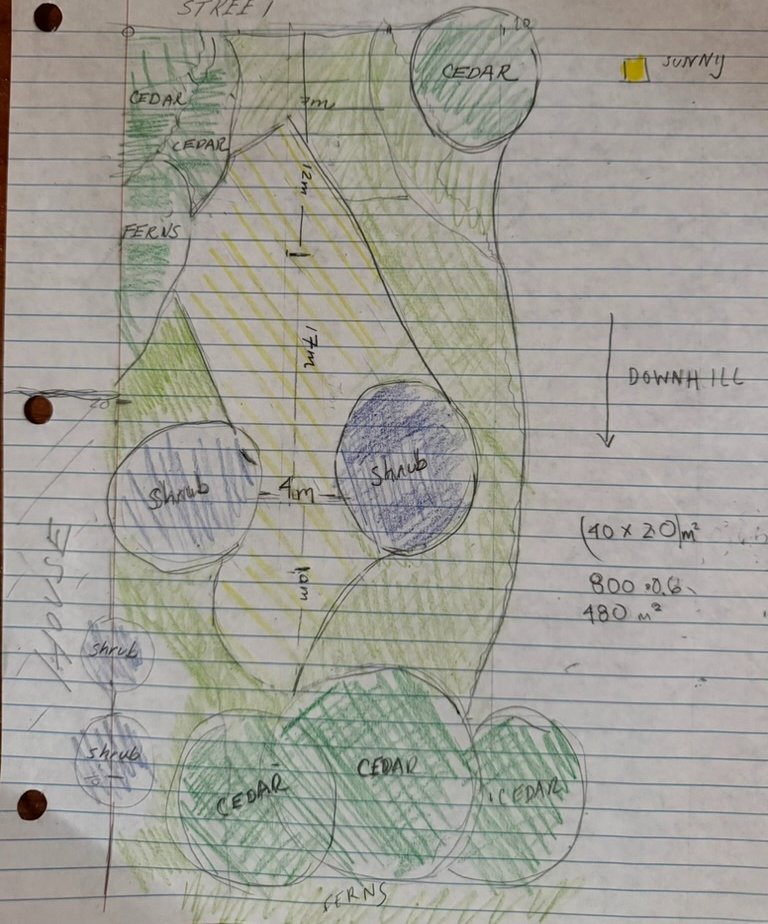
A diagonal strip of lawn, sunlit between six cedars and three shrubs, sown over to native prairie.
The lot is ringed in shade and edged in sun. Cedars and fern beds hold the perimeter; a diagonal wedge through the middle is the only ground that clears the canopy. The slope runs gently downhill across that wedge, which shapes how the seed and mulch are held in place.
Six mature cedars trace the edges of the lot along the street and back border, underplanted with fern beds that have filled in on their own. This ring stays as-is — it's the yard's shade structure.
A wedge of unobstructed sun runs diagonally through the center of the lot, roughly 480 m² — the only ground that clears the cedar canopy for most of the day. This is the meadow zone.
Three shrubs already anchor the sunny strip and stay in place as fixed points the meadow planting works around.
Lavender and sage, planted in clean rows along the edges of the strip. Clipped and predictable, they signal intention from the street and give the eye a resting point before the wild fill starts.
The interior of the strip is broadcast-seeded with a native prairie mix — grasses and forbs suited to the Salish Sea lowlands, left to grow and self-seed with minimal intervention.
Northwest Meadowscapes, Port Townsend, WA — native grass and wildflower seed collected and grown in the Pacific Northwest.
Slots to fill in as the conversion progresses — drop images in directly.
A mowed lawn turning into tall grass can look like neglect if you don't know what's happening. Here's the short version.
For the first season, some of the young plants look sparse or a little unruly before they establish. The lavender and sage on the edges stay clipped, and a mowed border runs the whole way around the strip, so it reads as a garden bed, not a neglected lawn.
A meadow strip isn't a food source or shelter that a mowed lawn doesn't already offer at similar rates. The plants draw pollinating insects and seed-eating birds. The mowed border keeps a clear line between the meadow and the house.
Turf on this strip would need regular mowing, watering, and fertilizer to look decent, and it supports close to no wildlife. A native meadow needs none of that once established, and it fits a sunny gap in the yard that grass never grew well in anyway.